Exciting changes are coming!
The Dignity Health website is moving to CommonSpirit.org to deliver a more patient-centered digital experience across CA, AZ, and NV.
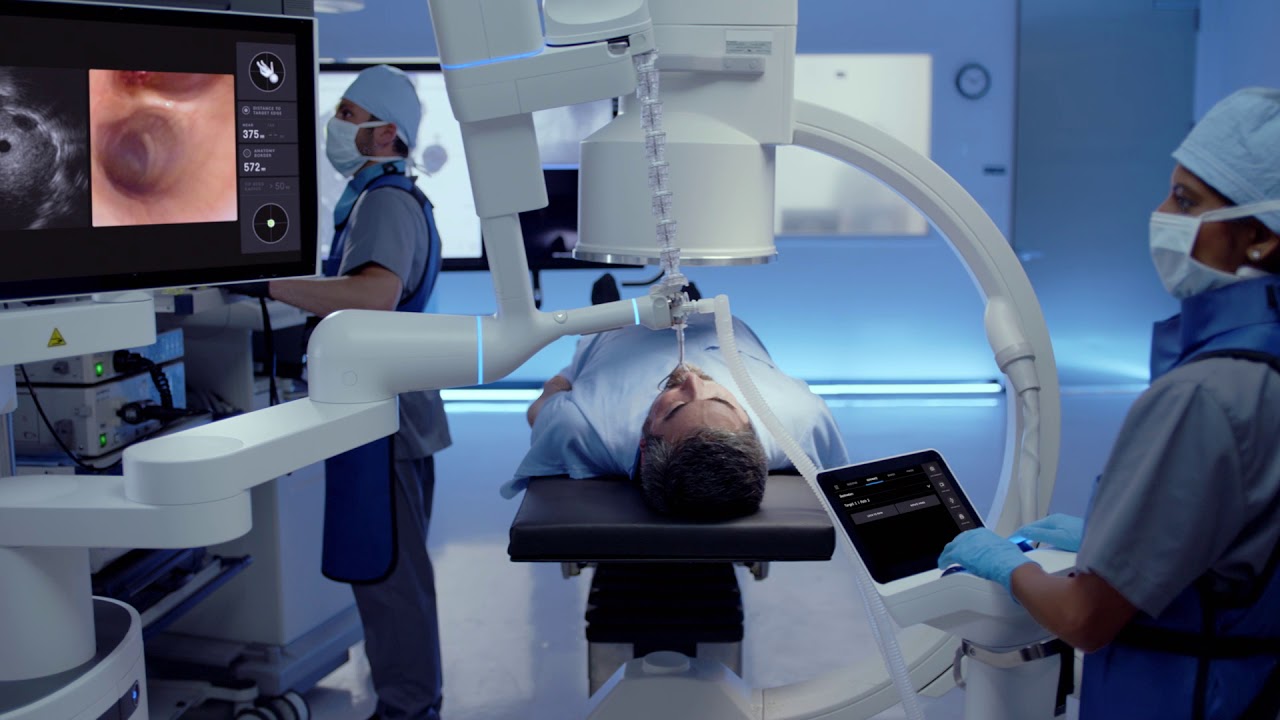
Dignity Health of Arizona, offers a minimally invasive robotic-assisted bronchoscopy procedure. With accurate precision and stability, Robotic bronchoscopy enables physicians to obtain tissue samples from deep within the lung, addressing a challenging aspect of lung biopsy.
During the Robotic bronchoscopy, your physician guides an ultra-thin catheter through your airway to the area of your lung for biopsy. The small, flexible catheter can reach all segments of the lung — even far into the outer lung. Once at the nodule for biopsy the catheter locks in place. Your physician inserts biopsy tools through the catheter to take a sample of your lung tissue.
Robotic bronchoscopy platform is designed for minimally invasive lung biopsies. This advanced system allows doctors to access all 18 segments of the lung to obtain tissue samples with greater precision and reach. Ion achieves this through:

If a spot or nodule has been found on your lung, your doctor might suggest a lung biopsy. While most lung nodules (over 95%) are not cancerous, a biopsy can provide a definitive diagnosis. A biopsy involves taking a small tissue sample from the nodule, which is then examined under a microscope to determine if cancer or another condition is present. There are different methods for performing a lung biopsy, and the best approach for you will depend on factors like the nodule's size, location, and your overall lung health. Your doctor may recommend one of the following biopsy methods:
When is a Lung Biopsy Needed?
Lung cancer screening with low-dose CT scans is a powerful tool for early detection, significantly improving treatment outcomes. If you've had a lung scan and your doctor has mentioned the possibility of a lung biopsy, you likely have questions. This section explains when a lung biopsy might be recommended and what to expect.
After your CT scan, a dedicated team of specialists, including radiologists, surgeons, and oncologists, will carefully review the images. The goal is to identify any abnormalities that require further investigation.
A lung biopsy is a procedure to remove a small sample of lung tissue for examination under a microscope. It's typically recommended when a lung scan reveals a suspicious area, such as a nodule or mass, and further information is needed to determine if it's cancerous or benign. Factors that may lead to a biopsy include:
Your doctor will discuss the specific reasons for recommending a biopsy with you, explaining the potential benefits and risks.
Our multidisciplinary team is committed to providing you with the best possible care. Our experienced radiologists, surgeons, and oncologists work together to ensure accurate diagnosis and personalized treatment plans.